#hackathon#building-in-public#ai-agents#debrief#nextjs
We Shipped Without the Credits. Here's How the AMD Hackathon Actually Went.
Samuel EzekielMay 10, 2026 at 7:44 PM5 min read741 Views
EXPAND VIEW
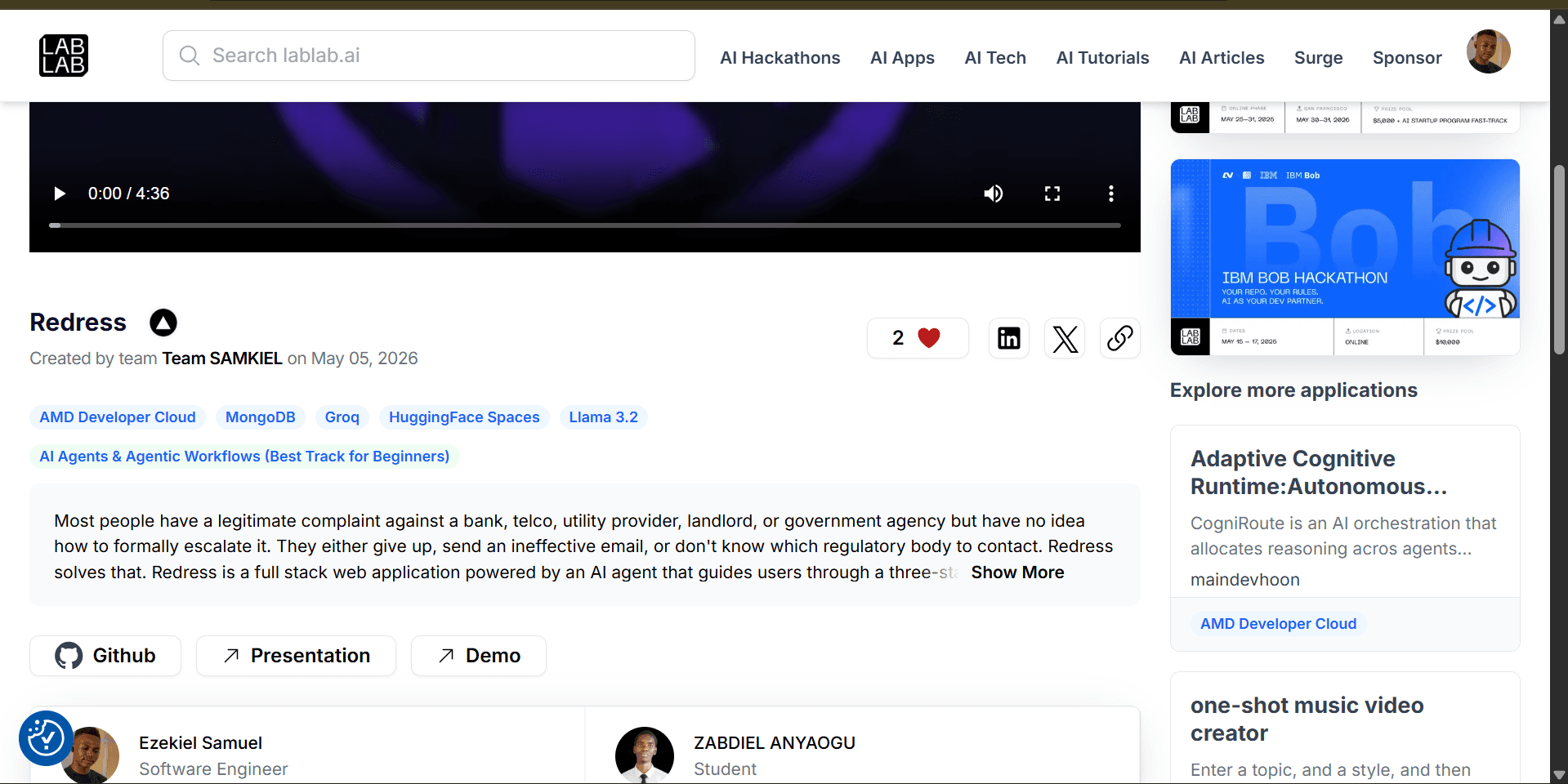
The AMD Developer Hackathon 2026 wrapped up today. Six days, an AI Agents track, and a submission I'm genuinely proud of — despite almost everything going sideways.
This is the honest version.
Redress — an AI complaint resolution agent.
The idea: most customer complaint processes are broken. You fill a form, wait three days, get a generic response, repeat. Redress puts an intelligent agent in the middle of that flow. It understands the nature of the complaint, routes it correctly, follows up intelligently, and actually resolves things — rather than just logging them.
The agent layer is what I'm most proud of. It's genuinely smart. Not "smart" in the way people say that to mean it works sometimes. Smart in the way where it makes the right call in cases I hadn't explicitly programmed for, and that surprised even me.
We started as three: me, Zabdiel, and Emmanuel.
Emmanuel dropped out early — no power, not a choice. That left two of us. Zabdiel and I split the work and got it done. Simple as that.
I've stopped being surprised by how hackathons shake out. You plan for a team, you build with whoever shows up.
The original plan was a Python/Django backend with a Next.js frontend. Clean separation, fast iteration on the agent logic in Python.
That plan lasted about 36 hours.
The overhead of coordinating a full Django API alongside the Next.js frontend — especially with one fewer person — was too much. Every config change echoed across two codebases. Every environment variable existed twice. I made the call to drop Django and go full-stack Next.js: server actions, API routes, the whole thing in one repo.
The right call. But not a free one.
Reconfiguring everything — environment variables, API integrations, project structure — in the middle of a time-boxed build is the kind of thing that doesn't sound hard until you're doing it at midnight with four days left. That was the hardest stretch of the whole build. Not a technical problem. A logistics and endurance problem.
This is the part I want to be transparent about.
The hackathon ran on AMD infrastructure. I applied for AMD developer credits on May 8th — two days before the submission deadline. The credits never came through.
No comments yet - start the discussion
I wasn't going to miss the deadline waiting on an email that might not arrive. So I submitted with Groq as the inference backend instead.
After submission, a moderator flagged the project for not using AMD services. I explained the situation — applied May 8th, never received access, submitted anyway rather than not submitting at all. That flag is probably the thing that costs us a placement, if anything does.
I don't have much to say about it beyond: I tried to use the required stack. The access didn't come. I adapted and shipped.
Results aren't out yet. I submitted on time. The project works. The agent is good.
Whether we place depends on how they weigh the infrastructure flag against the quality of what was built. I genuinely don't know how that goes.
What I do know: I'm not anxious about it. I built something real in six days with a reduced team, switched stacks mid-build, solved a problem I actually think matters, and hit the deadline. That's the thing I control.
The outcome is the outcome.
Apply for cloud credits the moment registration opens. Not when the build starts. Not when you remember. The moment you sign up. Credits, API access, sandbox environments — these things have approval queues that don't care about your deadline.
Agree on the stack before writing a line of code. The switch from Django to full-stack Next.js was the right move, but it should have been the plan from day one given the team size. Two people, one repo. That's the rule I'm taking into the next one.
Scope the agent tighter earlier. The smart agent behavior that I'm proud of? That came together in the last two days because I spent the first two days building around it rather than on it. The core intelligence should have been the first thing I proved out, not the last.
Hackathons are compression chambers. Six days of decisions that would normally take six weeks. Stack choices, scope cuts, team dynamics, infrastructure fires — all of it, compressed.
I came out of this one with a working product, a lesson about cloud access timelines, and a clearer sense of how I build under pressure.
That's enough. Results or not.
Redress was built for the AMD Developer Hackathon 2026 on lablab.ai — AI Agents & Agentic Workflows track. Results pending.